Painted Faces
Newcastle-under-Lyme was once home to over one hundred clock makers. Explore the history of Brampton Museum's beautiful collection with our research volunteer Catherine Burgass.
As a volunteer at the Brampton Museum I have been involved in some wonderful exhibitions and activities, most recently the Museum’s longcase clocks project. The Brampton holds 11 longcase, aka grandfather clocks. These are placed throughout the Museum, some in storage, while upstairs in the Victorian street scene is Mr Tildesley’s watchmaker’s shop.
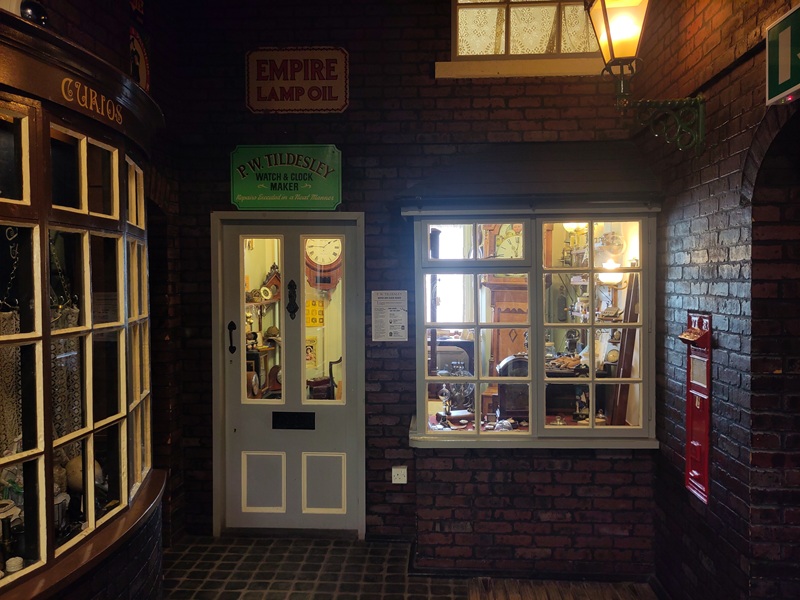
The longcase clocks are wonderful objects, made here in Newcastle-under-Lyme; some of them are centuries old, but all stand silent. They need expert help to restore them to former glory and start them ticking again and the Museum was visited recently by clock conservator Callum Scobie-Young: https://www.newcastle-staffs.gov.uk/blog/museumblog/post/10/a-rare-peek-inside-newcastle-s-historic-clocks.
Obviously, horology is a highly specialised subject but the general history is fascinating and the significance of clockmaking to NUL in bygone times is, pardon the pun, striking.
Clockmaking was established in Newcastle in the late seventeenth century and according to Joseph McKenna, ‘Eighteenth century Newcastle-under-Lyme supported more watchmakers and clockmakers than any other provincial town, with the exception of Birmingham.’ The wooden cases were made in Uttoxeter and the clock faces supplied from Birmingham.
These clock faces are a study in themselves – they were initially made of brass, supplanted by white painted and decorated faces. The first of these that the Museum visitor is likely to encounter is in the Borough in 80 Objects room. This clock is made by William Heath, who was apprenticed in Newcastle in 1798. The face is a complicated affair with separate sets of Arabic numerals for the hours, minutes and days of the lunar month. The top arch has a rotating disk with day and night scenes, but it is the four corners round the clock face (known as spandrels) that first caught my eye. They contain images representing the four continents as female figures. Europe holds the trident-like caduceus, a staff with wings and twining snakes. This is associated with the god Hermes, trade and skilful negotiation. In the background is a ship’s sail and rigging and in the foreground a globe, reinforcing the idea of Europe’s dominion over the world and its oceans.
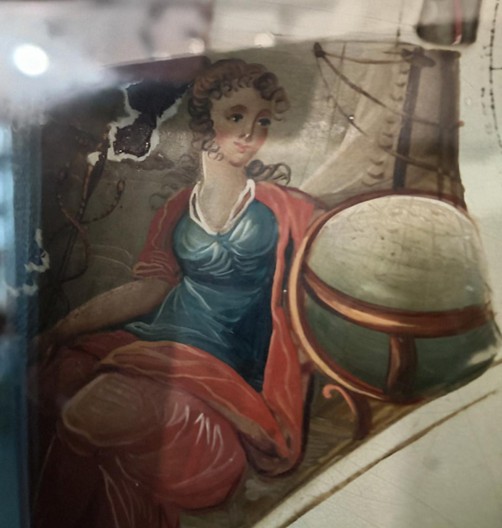
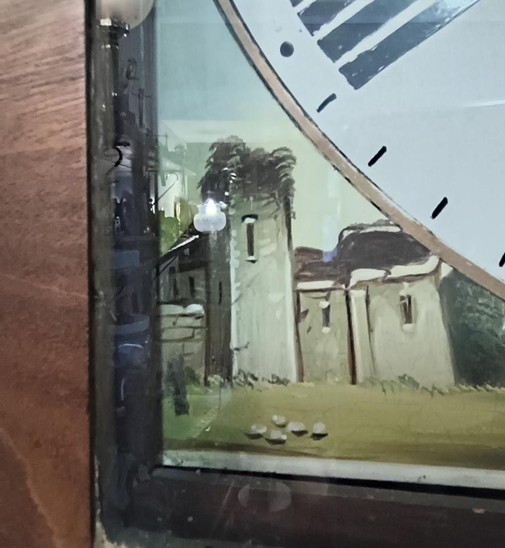
Asia is flanked by a camel, also a symbol of trade, and both figures are classically garbed. Africa, with lion, holds a spear and an elephant’s tusk. Her breast – like Native America’s – is bare, setting her apart from modestly clad Europe and Asia. There is, if you peer closely, what looks like a stone-built tower, perhaps a minaret, in the background. This suggests a city like Zanzibar which was central to the East African slave and ivory trade.
Clockface painting is often classified by the experts as folk art, an interesting category. The artwork on display at the museum is varied: some of the painting is of rustic scenes quite loosely rendered; some is more skilfully executed with reference to classical mythology and imitation of well-known works of art.
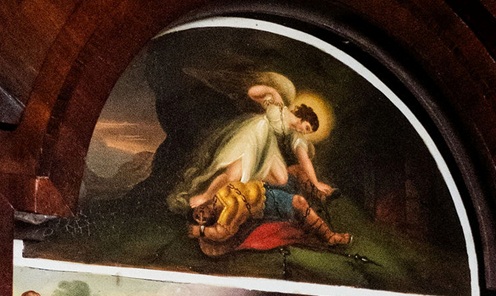
Sometimes the images are easy to identify, or so I thought – in Mrs Mosley’s Parlour stands a mid-nineteenth-century longcase clock by J.B. Copeland. The painting in the arch I had pinned as Archangel Michael defeating Satan, but another suggestion is the Liberation of Saint Peter.
In the top right-hand spandrel, the figure Justice is recognisable by her sword, scales and blindfold.
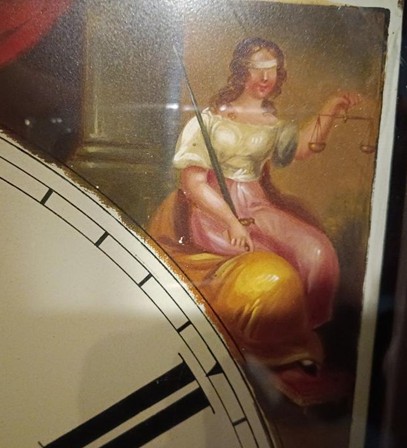
The blindfold was initially used to represent Justice as blind to injustice, only later carrying the modern meaning of impartiality.
There is something of a mystery in Mr Tildesley’s shop in the form of a bracket clock by Francis Chambley, who had his own shop in Red Lion Square in the early 1800s. Could the figure in the top left-hand spandrel be holding a bunch of grapes, or perhaps a swarm of bees? The latter would make her Melissa, the nymph of Greek mythology who discovered the uses of honey.
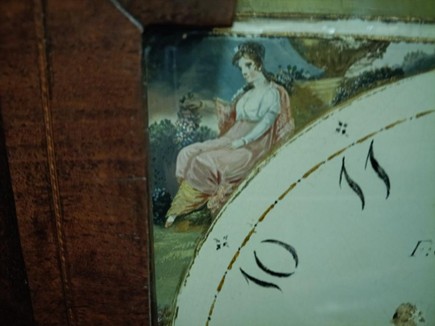
These clockfaces are well worth a second look and the clocks themselves are not just lovely objects but a reminder of Newcastle’s economic history.
The term grandfather clock was only introduced after the heyday of British clockmaking and comes from the 1876 song ‘My Grandfather’s Clock’ by American Henry Clay Work. UK trade had declined in large part due to cheap European and American imports and by 1901 there was only one clockmaker left in Newcastle. The Brampton longcase clocks have – in the words of Work’s song – stopp’d short, but one day soon will chime again.
By Catherine Burgass - volunteer
Particular thanks to Keele University Library and Jason Condliffe for sourcing the research texts
Share and Enjoy: These icons link to social bookmarking sites where readers can share and discover new web pages.


